

Dental implants : restoring a missing tooth
- Posted on 17/10/2023 15:45
- Film
- By abelozih@sante-education.tg
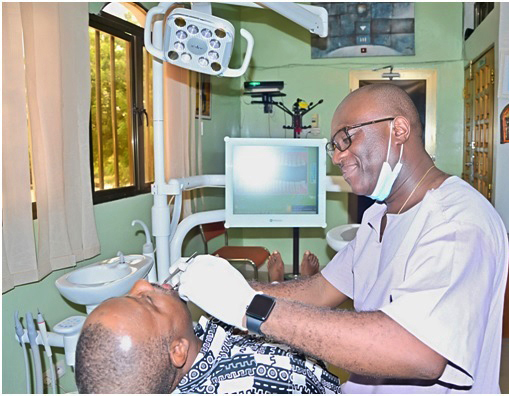
Extract from the article: An implant is a type of titanium screw, fixed in the bone like the root of a natural tooth. According to Dr Georges Tokofai, President of the Ordre National des Chirurgiens-Dentistes du Togo (ONCDT) and Director of the Centre Dentaire International d
An
implant is a type of titanium screw, fixed in the bone like the root of a
natural tooth. According to Dr Georges Tokofai, President of the Ordre National
des Chirurgiens-Dentistes du Togo (ONCDT) and Director of the Centre Dentaire
International de Lome (CDIL), « the implant allows the missing tooth to
be replaced without affecting the other teeth. This is why the practitioner
adapts the length, diameter and shape to the clinical case using a
high-performance radiological examination: 3D or scanner ».
The
implant protocol
First
of all, the practitioner must gain access to the bone, freeing the gum. To do
this, he makes an incision using a scalpel, then removes the gum to give a
clear view of the operating field. Today, 3D scanners that reproduce the
precise anatomy of the jawbone on a computer allow much less invasive surgery
in common cases (the so-called « flapless » technique).
« Implantology
is an essential breakthrough that has improved the lives of thousands of
patients. In fact, it is often the optimal solution because : it avoids the
needless sacrifice of healthy teeth, it is the only way to avoid a removable
prosthesis, the patient regains the comfort of original teeth and therefore an
incomparable quality of life - the aesthetics are optimal, it avoids the bone
loss associated with the extraction of a tooth », explains
Dr Georges Tokofai, President of the ONCDT.
Clearly,
a dental implant is the optimum solution if one or more teeth are missing. This
means that almost everyone can benefit from a replacement solution for their
teeth, with an appearance and function identical to those of a natural tooth. « However,
it is important to have fully developed bone tissue beforehand.This explains
why dental implants are not normally fitted to people under the age of
18 », explains Dr Georges Tokofai.
How
do we proceed?
Dr
Georges Tokofai explains that the implantologist will use drills of the
appropriate diameter to prepare the space in the bone. « The implant
penetrates the bone with slight force. This stabilises it.Once the implant has
been placed, the osseointegration phase takes place.Unlike the tooth, the
implant is completely fixed, i.e. ankylosed in the bone.The loading of the
implant is generally deferred to allow for the osseointegration phase (from
several weeks to several months). A crown will then be placed on the implant,
which will act like an artificial root », explains the dental
surgeon.The "SOS DENTISTE" dental practice is the first to introduce
implantology in Togo.After several training courses, notably in France, the
first implant was placed in Togo by Dr Georges Tokofai on 21 January 2009. To
ensure the safety of this particular surgery, a surgical clean room (surgical
block) is specially reserved for him within the practice.
William
O.