
How do you recognise genuine quality wagashi in Togo?
- Posted on 17/12/2024 10:57
- Film
- By abelozih@sante-education.tg
Extract from the article: Quality wagashi can be recognised not only by its appearance and taste, but also by the ingredients used in its preparation. Each wagashi should tell a story through its flavours and presentation, offering a unique and memorable eating experience.
Quality wagashi can be recognised not only by
its appearance and taste, but also by the ingredients used in its preparation.
Each wagashi should tell a story through its flavours and presentation,
offering a unique and memorable eating experience.
To
recognise good quality wagashi in Togo, it is essential to consider a number of
criteria relating to its manufacture, appearance and hygiene conditions. Here are a few key points to bear in mind:
Origin
and manufacture
Authentic
wagashi is made from fresh milk from local cows, without the addition of
powdered milk or other substitutes. Always make sure that the wagashi comes
from local producers and processors who are recognised for respecting good
hygiene practices in their activities. It should be prepared using traditional
methods that have been carefully mastered, to guarantee authentic taste and
texture.
Appearance
and texture
A
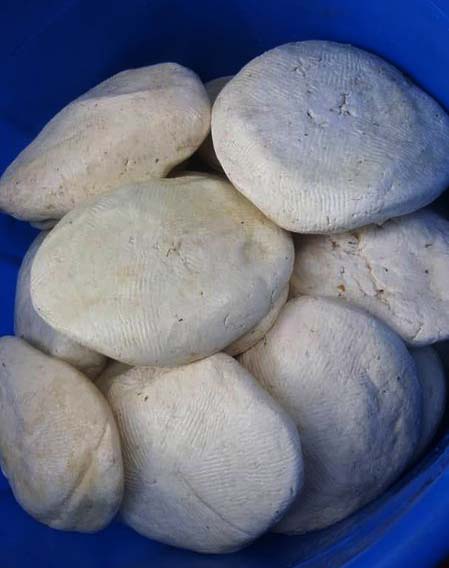
good wagashi is white or slightly creamy in colour, with no stains or
discolouration, and should have a soft texture.
However, there may be variations in colour, particularly in red, which
could be due to the addition of ingredients such as spices or natural
colourings. A quality wagashi should
have a mild, slightly salty flavour.
The
perception of a bitter or unpleasant taste on tasting may be associated with
the use of chemical additives to prolong its shelf life. The wagashi should be
free of mould or unpleasant odours, which could indicate deterioration.
The
texture varies according to the type of wagashi. Fresh wagashi has a soft
texture, while boiled wagashi has a firm texture. Wagashi with a good texture
is not crumbly. If granules or residues other than calotropis procera are
detected in the wagashi, this could indicate a mixture of soya milk with cow's
milk.
Hygiene
conditions
It
is important to check that the seller complies with strict hygiene standards
when handling and selling the cheese.This includes wearing gloves and keeping
the sales area clean. Wagashi must be stored in appropriate conditions,
respecting the cold chain, to avoid contamination. If the cheese is displayed
for sale, it must be protected in packaging away from flies, dust and handling
by customers.Handling by several people without respecting hygiene standards
can introduce contaminants, increasing the risk of food-borne illness.
Raising
awareness of food safety
There
is growing interest in the economic development of wagashi. This is why
initiatives are being taken to structure the industry and protect the know-how
associated with its production.Organisations such as Vétérinaires Sans
Frontières Suisse (VSF-Switzerland) and Gestion de l'Environnement et
Valorisation des Produits Agro Pastoraux et Forestiers (GEVAPAF) are working to
raise consumer awareness of the importance of demanding the highest standards
of hygiene when buying wagashi.Their project entitled ‘Wagashi sain pour une
Optimisation des revenus des Ménages Exploitant le lait local au Nord Togo’
(WOMEN), supported financially by ECOWAS and Swiss Cooperation, aims to improve
the income and resilience of vulnerable households in the prefectures of Oti,
Oti-Sud and Kpendjal, by providing greater support for the processing and
marketing of wagashi (a traditional cheese made from cow's milk).
The
WOMEN project represents a significant initiative to strengthen the local
economy in northern Togo while promoting a traditional product that is
essential to the region's food culture.
William O.
Contacts
for ordering good wagashi from cooperatives in the Savanes Region (Togo)
Tel
/ WhatsApp : +228 93096504/ 90996998/93995375