

Tooth whitening: what are the risks? Answers from Dr Georges Tokofai, Director of the Lomé International Dental Centre (CDIL)
- Posted on 24/03/2023 16:14
- Film
- By abelozih@sante-education.tg
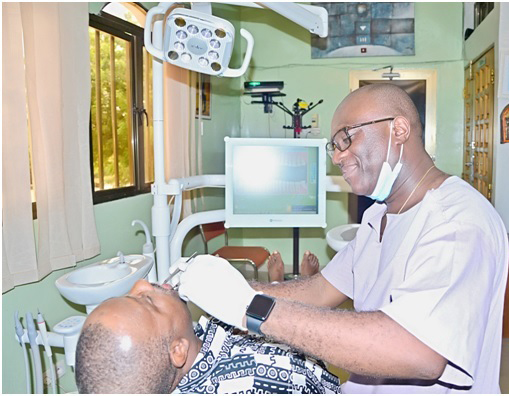
Extract from the article: Tooth whitening refers to procedures aimed at lightening the colour of the teeth. This procedure is generally performed by a dental surgeon, but it is increasingly offered in beauty salons. Scaling is the first step because only teeth that are alread
Tooth
whitening refers to procedures aimed at lightening the colour of the teeth.
This procedure is generally performed by a dental surgeon, but it is
increasingly offered in beauty salons. Scaling is the first step because only
teeth that are already clean are lightened. Scaling is therefore a
"must" before bleaching. It is a medical procedure. It must be
performed by an oral health professional. It consists of removing tartar and
plaque by « scraping », and above all polishing the surface of the
teeth to recreate a healthy environment and facilitate their cleaning. In most
cases, for superficial staining, this simple scaling can be sufficient as the
teeth regain their natural brightness and whiteness. Hence the importance of a
consultation with the dentist for a precise diagnosis before any treatment.
In
the case of a more persistent or unsightly discolouration, it will be necessary
to resort to a dental lightening technique commonly known as dental bleaching.
Tooth whitening requires a thorough examination by the dental professional as
not all teeth can be treated. The teeth must be prepared for the treatment by
first addressing any pre-existing cavities, gum disease or other conditions
that may complicate, prevent or hinder successful whitening.
Bleaching
techniques
There
are two professional whitening techniques, always performed by a dentist who
has mastered the techniques of cosmetic dentistry: whitening performed in the
dentist's office, whitening performed at home by the patient himself or
herself, or both techniques combined, i.e. whitening performed in the office
followed by whitening performed at home
The
products used depend on the technique used. Hydrogen peroxide and carbamide
peroxide are the most commonly used. There are precise concentrations that must
be respected for a better result. These products are effective but not without
risks. The more hydrogen peroxide it
contains or releases, the more effective and potentially dangerous the product
is. Similarly, tooth whitening may be contraindicated in some cases. The
product is particularly harmful to teeth with cavities, wear lesions or
hypersensitivity.
It
is this whitening agent that can be dangerous. It is this whitening agent that
can be dangerous, because undiluted hydrogen peroxide can be fatal if swallowed
in large quantities.
Consult
a dental practice
In
view of these risks, we formally advise people against having this type of
treatment in beauty salons, smile bars or other beauty workshops. The treatment
must be done in a dental office run by qualified and experienced professionals
in the field. It should be noted that the whitening products used by
non-professionals in the field of oral health have a very low concentration and
are therefore not effective for a reproducible and satisfactory result for the
patient or client.
The
dentist alone controls the concentration of the products and their application
time for an optimal result. And above all, avoiding unfortunate consequences on
the health of the mouth and teeth and on the general health of the patient. It
is therefore essential to make an appointment with the dental surgeon before
starting any dental bleaching treatment.
Interview
by William O.